---
title: Writing a Goal Statement to Change a Behaviour & Habit - Optimus Performance
description: To change a behaviour requires being acutely aware and conscious of oneself as behaviours are linked to deep rooted beliefs, attitudes and habitual thinking. The type of person we are fuels these behaviours that can sometimes be perceived as negative by others. In my previous article and video in this series I used
---
Follow :
[tel:514-946-2455](tel:514-946-2455) [514-946-2455](tel:514-946-2455)
[](https://www.optimusperformance.ca)
- [Home](https://www.optimusperformance.ca)
- [Solutions](https://www.optimusperformance.ca/solutions)
- [Resources Hub](https://www.optimusperformance.ca/the-resources-hub)
- [Contact](https://www.optimusperformance.ca/contact-us)
- [Blog](https://www.optimusperformance.ca/blog)
- [Home](https://www.optimusperformance.ca)
- [Solutions](https://www.optimusperformance.ca/solutions)
- [Resources Hub](https://www.optimusperformance.ca/the-resources-hub)
- [Contact](https://www.optimusperformance.ca/contact-us)
- [Blog](https://www.optimusperformance.ca/blog)
[Contact Us](https://www.optimusperformance.ca/contact-us)
[changing behaviour](https://www.optimusperformance.ca/blog/tag/changing-behaviour) [leadership training](https://www.optimusperformance.ca/blog/tag/leadership-training) [executive coaching](https://www.optimusperformance.ca/blog/tag/executive-coaching) [goal planning template](https://www.optimusperformance.ca/blog/tag/goal-planning-template)
# Writing a Goal Statement to Change a Behaviour & Habit
[Stephen Goldberg](https://www.optimusperformance.ca/blog/author/stephen-goldberg) Jul 16, 2026, 6:40:31 PM
To change a behaviour requires being acutely aware and conscious of oneself as behaviours are linked to deep rooted beliefs, attitudes and habitual thinking. The type of person we are fuels these behaviours that can sometimes be perceived as negative by others.
In my previous [article and video](https://www.optimusperformance.ca/develop-better-habits-improve-leadership-personal-performance/) in this series I used the example of the classic type of person whose main motivation is accomplishment and whose fear is ineffectiveness. In fact, this is my type so I am using myself as an example in the goal setting process.
To make this practical for you I have made available a [goal planning form](http://optimusperformance.us2.list-manage1.com/subscribe?u=b9133a3181ffa04d7802e1ec5&id=d0fe87fb14) that you can [download here](http://optimusperformance.us2.list-manage1.com/subscribe?u=b9133a3181ffa04d7802e1ec5&id=d0fe87fb14). To identify your type, I suggest buying the book [CrazYZoo! Know-Thyself Made Easy](http://goo.gl/bA16kU) by Fritz Glaus as he walks you through the six classic types and provides an exercise for you to discover your type.
Whether you use the type approach or just choose a behaviour you want to change, the process is the same.
**[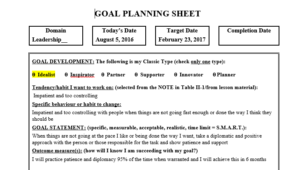](https://www.optimusperformance.ca/hubfs/Imported_Blog_Media/Goal-form-types-example.png)Step One: Tendency or Behaviour**
The first step is to write down the tendency or behaviour to change. In my case it is impatience and controlling. When I feel things are not being done effectively I tend to become impatient and too controlling. On my goal planning sheet, I wrote down impatient and controlling. You can [download the form and my example here.](http://eepurl.com/ccGNlX)
**Step Two: Describe Tendency or Behaviour to Change**
Now write down the specific tendency or behavioural habit to change in more detail. In my case it is; Impatient and too controlling with people when things are not going fast enough or done the way I think it should be.
**Step Three: Write Goal Statement**
Write the goal statement following the S.M.A.R.T. principle (specific, measurable, acceptable, realistic, time limit). My example is; When things are not going at the pace I like or being done the way I want, take a diplomatic and positive approach with the person or those responsible for the task and show patience and support.
**Step Four: Outcome Measure**
The outcome defines the expected change and how you will know if your goal has been achieved. My personal example is; I will practice patience and diplomacy 95% of the time when warranted and I will achieve this in 6 months. I wrote 95% of the time as I feel it is unrealistic to expect perfection.
It is extremely important to write down your goal. This makes for a stronger commitment and provides more clarity to visualize achieving the goal. It also makes follow-up and measurement very tangible.
In my next article and video, I will continue the goal setting example and cover the topics of benefits, follow-up, roadblocks, solutions and more.
Previous Post
###### [Is servant leadership the answer to the recession?](https://www.optimusperformance.ca/blog/is-servant-leadership-the-answer-to-the-recession)
Next Post
###### [How to Overcome Common Constraints and Achieve Your Goals](https://www.optimusperformance.ca/blog/how-to-overcome-common-constraints-and-achieve-your-goals)
### Similar Blog Posts
[](https://www.optimusperformance.ca/blog/training-programs/langfr)
##### [Training Programs](https://www.optimusperformance.ca/blog/training-programs/langfr)
[](https://www.optimusperformance.ca/blog/training-programs)
##### [Training Programs](https://www.optimusperformance.ca/blog/training-programs)
[](https://www.optimusperformance.ca/blog/assesment-tools)
##### [Assessment Tools](https://www.optimusperformance.ca/blog/assesment-tools)

Follow :
© 2026 Optimus Performance Inc.
[Privacy Policy |](https://www.optimusperformance.ca/privacy-policy) [Terms & Condition](https://www.optimusperformance.ca/terms-and-conditions-of-use)
```json
{
"@context" : "https://schema.org",
"@type" : "BlogPosting",
"author" : {
"@type" : "Person",
"name" : "Stephen Goldberg",
"url" : "https://www.optimusperformance.ca/blog/author/stephen-goldberg"
},
"dateModified" : "2026-07-16T22:40:31.480Z",
"datePublished" : "2026-07-16T22:40:31.000Z",
"headline" : "Writing a Goal Statement to Change a Behaviour & Habit - Optimus Performance",
"mainEntityOfPage" : {
"@id" : "https://www.optimusperformance.ca/blog/writing-goal-statement-change-behaviour-habit",
"@type" : "WebPage"
},
"publisher" : {
"@type" : "Organization",
"logo" : {
"@type" : "ImageObject",
"url" : "https://www.optimusperformance.ca/hubfs/Optimus-Performance-Logo-2.png"
},
"name" : "Optimus Performance"
}
}
```